PROJECT
Utopian Remembrance
Ongoing project since 2022
Research and remembrance work on the Eva Mamlok Group as an ongoing model of Utopian Remembrance.
Utopian Remembrance
Ongoing project since 2022
Research and remembrance work on the Eva Mamlok Group as an ongoing model of Utopian Remembrance.
The principle of Utopian Remembrance shapes the research, the work of memory, and the educational engagement around the Eva Mamlok group.
At its core lies the exploration of the resistance of these young women during National Socialism: telling their stories, uncovering data and facts in archives, and developing from them a narrative that can become effective in various formats of education and remembrance work.
What began in the Galerie Auslage project with initial research and presentations in diverse artistic formats evolved into continuous collaboration within a research group.
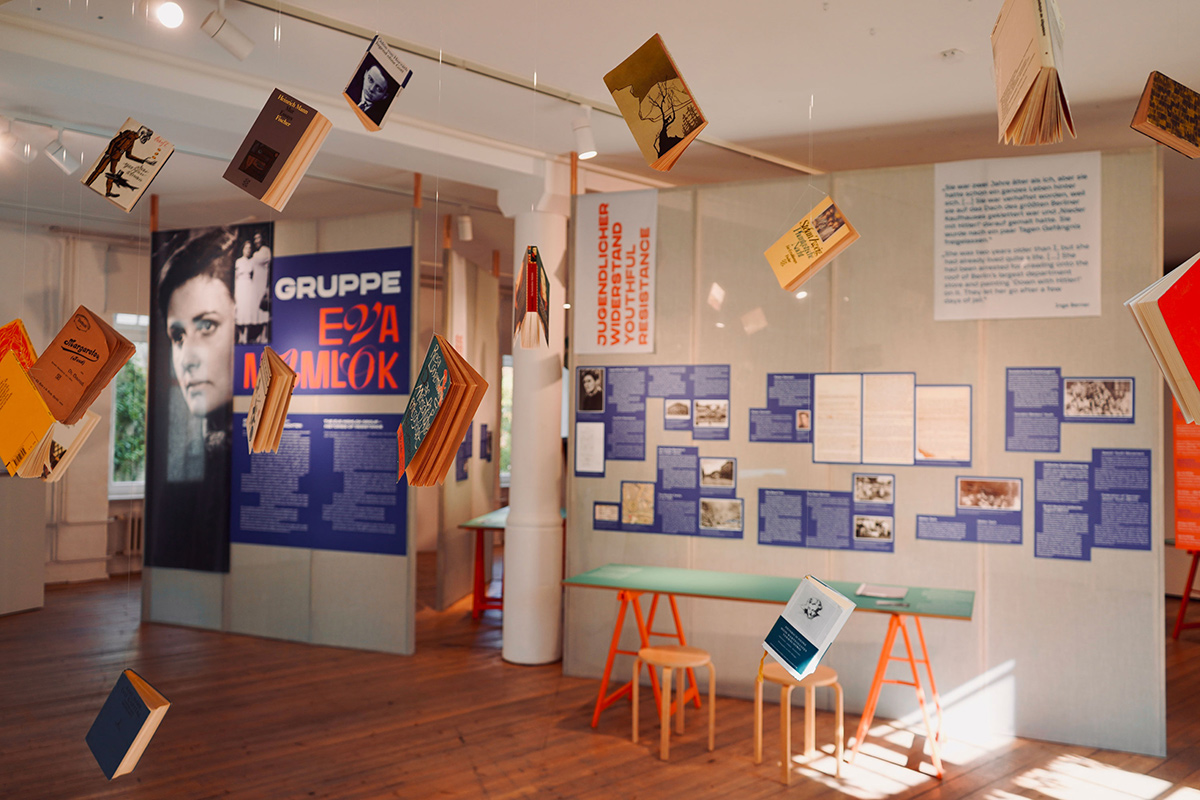
In the summer of 2024, this work culminated in the exhibition Histories of Resistance: Eva Mamlok Group at the FXHB Museum, which inspired numerous actors to launch their own political remembrance projects around Eva Mamlok.
In 2025, as part of the series Women in Resistance, a postage stamp will be issued to honor Eva Mamlok. The reading room of the Rosa Luxemburg Foundation now bears her name. An initiative set in motion the process of renaming Blücherplatz to Eva-Mamlok-Platz — scheduled for 2026.
In parallel, a book project is being developed at Verbrecher Verlag.
Another project has begun to link the resistance of Eva Mamlok’s group with other political struggles located around what is still Blücherplatz / soon Eva-Mamlok-Platz. In this way, the principle of Utopian Remembrance takes on an intersectional dimension: a remembrance that connects different struggles for emancipation and solidarity, and makes them visible within the urban space.
Another focus is on deliberately reaching young people through cultural education, especially via digital media, to open up access to the topic. The aim is to spark interest, encourage their own research, and enable them to discover connections and draw their own conclusions.
Utopian Remembrance means, on the one hand, remembering a resistant past and retelling its stories anew again and again; and on the other hand, envisioning remembrance as a political practice directed toward the future — as a foundation for democracy and democratic action in our society.
At its core lies the exploration of the resistance of these young women during National Socialism: telling their stories, uncovering data and facts in archives, and developing from them a narrative that can become effective in various formats of education and remembrance work.
What began in the Galerie Auslage project with initial research and presentations in diverse artistic formats evolved into continuous collaboration within a research group.
In the summer of 2024, this work culminated in the exhibition Histories of Resistance: Eva Mamlok Group at the FXHB Museum, which inspired numerous actors to launch their own political remembrance projects around Eva Mamlok.
In 2025, as part of the series Women in Resistance, a postage stamp will be issued to honor Eva Mamlok. The reading room of the Rosa Luxemburg Foundation now bears her name. An initiative set in motion the process of renaming Blücherplatz to Eva-Mamlok-Platz — scheduled for 2026.
In parallel, a book project is being developed at Verbrecher Verlag.
Another project has begun to link the resistance of Eva Mamlok’s group with other political struggles located around what is still Blücherplatz / soon Eva-Mamlok-Platz. In this way, the principle of Utopian Remembrance takes on an intersectional dimension: a remembrance that connects different struggles for emancipation and solidarity, and makes them visible within the urban space.
Another focus is on deliberately reaching young people through cultural education, especially via digital media, to open up access to the topic. The aim is to spark interest, encourage their own research, and enable them to discover connections and draw their own conclusions.
Utopian Remembrance means, on the one hand, remembering a resistant past and retelling its stories anew again and again; and on the other hand, envisioning remembrance as a political practice directed toward the future — as a foundation for democracy and democratic action in our society.